
Inside a Kitchen Cabinet: Backs, Bottoms and Partitions
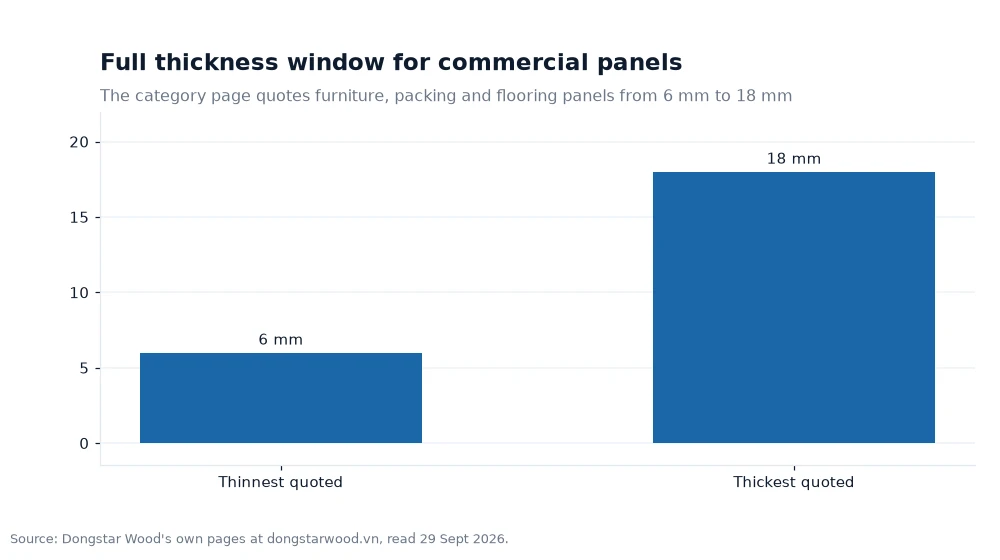
A kitchen cabinet is a set of panels doing different jobs, and the category pages of a Vietnam mill reflect that. Dongstar Wood quotes 6–9 mm for backs, drawer bottoms and partitions, 12–15 mm for office furniture, shelves and hotel fixtures, and 18 mm for heavy-duty furniture, worktops and structural panels. Choosing the right panel for each position is a specification exercise, not a price exercise.

Key takeaways
- Backs, bottoms and partitions sit in the 6–9 mm window, where the carcass supports the panel around its edges.
- Shelves, office furniture and hotel fixtures are quoted at 12–15 mm, the middle of the published range.
- Heavy-duty furniture, worktops and structural panels take 18 mm, and contractors often standardise 12 mm and 18 mm.
- Glue class follows the room: MR for dry interiors, BWR for humidity and light water exposure.
Where each panel sits in a cabinet
Strip a cabinet down and the panels are not interchangeable. The back is a thin sheet that closes the carcass and keeps dust out; the bottom carries the drawer and the load inside it; the partition divides space and stiffens the box; the shelf spans between sides and holds the weight. Each position asks something different of the panel, which is why a single thickness for the whole cabinet is a compromise rather than a specification.
The category page names the positions directly: furniture plywood for the visible and structural parts, with backs, drawer bottoms and partitions called out as their own group. The uses listed alongside them — cabinet, construction, packing and flooring — show how wide the category is, and why the thickness guidance matters more than the product name when a buyer is matching a panel to a position.
The thickness ladder: 6–9, 12–15 and 18 mm
The published guidance forms a ladder with three rungs. At the bottom, 6–9 mm covers cabinet backs, drawer bottoms and partitions, where the panel is held on all sides and never spans a free distance. In the middle, 12–15 mm covers office furniture, shelves and hotel fixtures, where a panel has to stay flat across a span while carrying weight. At the top, 18 mm covers heavy-duty furniture, worktops and structural panels, where the panel itself is the structure.
Contractors often standardise on two rungs — 12 mm and 18 mm — across a whole fit-out, so that one specification covers most of the job and the ordering stays simple. That habit is worth copying even for a single kitchen: fixing the two thicknesses before the quote means the comparison between suppliers happens on the same panels, not on two different interpretations of "furniture grade".
Face veneers and cores named on the category page
The page lists face veneers of birch, pine, bleached poplar, EV and rose eucalyptus, and cores of acacia, bodhi, eucalyptus and combi. For a cabinet, the face veneer is the visible surface and the core is what holds the screws and the flatness. A birch face gives a pale, even surface that takes stain or paint; a pine face is softer and suits painted furniture; bleached poplar lightens the look without changing the structure.
The core choice runs on the same logic. Acacia and eucalyptus cores bring density and screw-holding; bodhi and combi cores balance stability and cost. The category describes its output as furniture plywood, hardwood plywood and veneer plywood, and that trio covers most of what a cabinet shop orders: a decorative face, a stable core, and a panel that machines cleanly when the doors and drawers are cut.
Glue classes: MR for dry rooms, BWR for humidity
Glue class is the specification that fails quietly. MR, moisture resistant, is the right choice for dry interiors — living rooms, bedrooms, offices — where the panel never meets more than ambient humidity. BWR, boiling water resistant, is the step up for humidity and light water exposure: kitchens, bathrooms and utility rooms where steam and splashes are part of the room's normal life.
The choice is about the room, not the budget. An MR panel in a humid room will not fail on day one; it will fail at the edges over years, when the glue line absorbs moisture and the panel swells. Specifying BWR for the wet rooms and MR for the dry ones is the lowest-cost insurance a cabinet programme can buy, and it costs nothing at the quotation stage because both classes are published options.
Why EU buyers look at this category
Six reasons appear on the category page for EU customers, and they read like a checklist for exactly the comparison a kitchen programme needs: more affordable and cost-effective supply than Chinese factories, stable monthly supply, strong quality control at each production stage, custom size and core structure and glue and face veneer and grade, competitive wholesale pricing and flexible minimum order quantities with fast delivery to Europe.
Two of those reasons are documents rather than claims. The duty position — the manufacturer lists No Anti-Dumping Tax for European and US shipments — is a landed-cost fact that belongs in the comparison before price. The certification set, ISO, CE, SGS, FSC, EUDR and BSCI, defines which certificates can be requested for the panels once they arrive. A Commercial Plywood category that publishes both is easier to buy from than one that publishes neither.
| Cabinet position | Quoted thickness | What the panel has to do |
|---|---|---|
| Backs, drawer bottoms, partitions | 6–9 mm | Close the carcass, stay flat, hold screws at the edges |
| Shelves, office furniture, hotel fixtures | 12–15 mm | Span between sides and carry weight without sagging |
| Heavy-duty furniture, worktops, structural panels | 18 mm | Act as the structure and resist point loads |
| Wet rooms (kitchens, bathrooms) | BWR glue class | Resist humidity and light water exposure at the edges |
Worked example: one sheet against a kitchen run
Example: a standard sheet of 1220 × 2440 mm covers 1.22 m × 2.44 m = 2.9768 m². A run of six base cabinets needs six back panels of roughly 0.7 m × 0.5 m = 0.35 m² each, so 6 × 0.35 = 2.1 m² of back panel in total. One sheet covers the backs with 2.9768 − 2.1 = 0.8768 m² left over, which is enough for the drawer bottoms of the same run.
Example: the same arithmetic checks the shelves. Four shelves of 0.6 m × 0.3 m = 0.18 m² each need 4 × 0.18 = 0.72 m², which fits inside the offcut from the backs. These two planning estimates, based on published sizes and labelled as examples, demonstrate why the thickness ladder and the sheet size have to be fixed before the quotation is requested.
Frequently asked questions
Which thickness should a cabinet back be?
The category page quotes 6–9 mm for backs, drawer bottoms and partitions, where the panel is supported by the carcass around it. Within that window the choice is about flatness and screw-holding rather than strength.
When does a cabinet need 18 mm panels?
For heavy-duty furniture, worktops and structural panels, where the panel itself carries load. Contractors often standardise 12 mm and 18 mm across a fit-out so that one specification covers most of the job.
What is the difference between MR and BWR glue?
MR, short for moisture resistant, suits dry interiors; BWR, short for boiling water resistant, covers humidity and light water exposure. The glue class should match the room the cabinet will live in, not the price of the panel.
From the ladder to a specification
With the positions and the rungs fixed, a cabinet specification becomes a short list rather than a conversation. The company's own profile confirms the factory behind the category — established 2009, 48,000 m² of production space in Yen Bai Province — and the birch plywood product page shows the face veneer and compliance options for the visible parts of the same kitchen. A buyer who fixes the thickness ladder first spends the quotation comparing panels, not definitions.
Values used throughout were lifted from the mill's website recorded on 29 September 2026[1].